
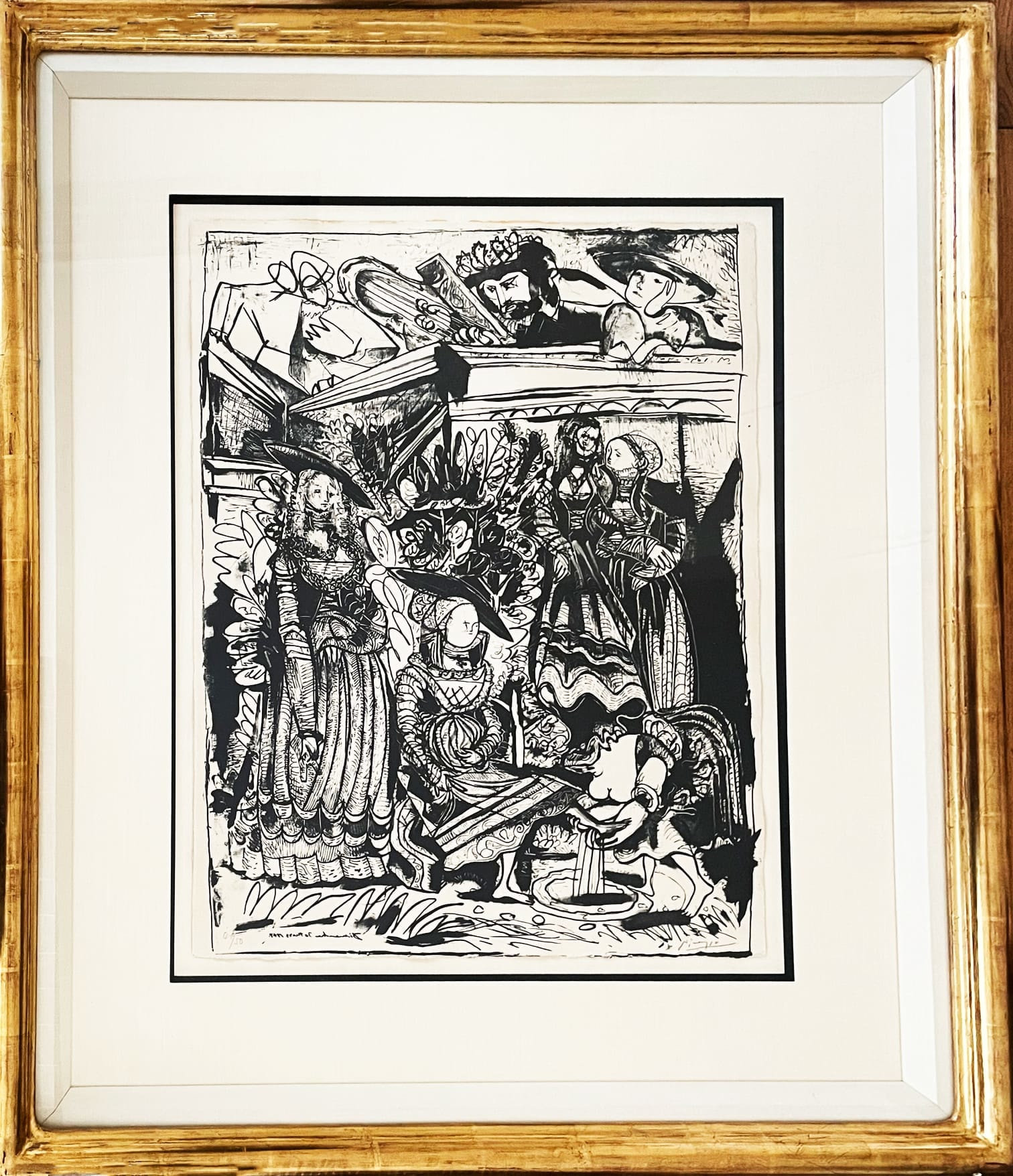
Picasso David and Bathsheba After Luc
Condition reports and provenance available upon request
About This Work
In *Picasso David and Bathsheba After Luc*, Pablo revisits the biblical encounter through a modernist lens, fusing art-historical quotation with boldly reduced form. Borrowing from Luc’s compositional precedent, the artist compresses narrative into charged contours and decisive spatial breaks, allowing line to carry both psychological tension and sensuality.
The palette and facture—at once economical and assertive—underscore a signature dialogue between figuration and abstraction, where bodies become symbols and symbols become bodies. This contemporary reinterpretation foregrounds themes of power, gaze, and moral ambiguity, situating a canonical story within 20th-century visual language.
The work speaks to Picasso’s enduring cultural relevance: the capacity to remake tradition while questioning how myth, desire, and authority are pictured.
About the Artist
Pablo Ruiz Picasso (25 October 1881 – 8 April 1973) was a Spanish painter, sculptor, printmaker, ceramicist, and theatre designer who spent most of his adult life in France. One of the most influential artists of the 20th century, he is known for co-founding the Cubist movement, the invention of constructed sculpture, the co-invention of collage, and for the wide variety of styles that he helped develop and explore. Among his most famous works are the proto-Cubist Les Demoiselles d'Avignon (1907) and the anti-war painting Guernica (1937), a dramatic portrayal of the bombing of Guernica by Germ…
Zebra One Gallery
Contemporary Art • Hampstead, London
Established 1976 • 50 years of excellence in contemporary art • Professional authentication and provenance research